A free, local-first desktop workspace for molecular records, structure recognition, spectra, separations, bench calculations, 3D viewing, and cofactors.
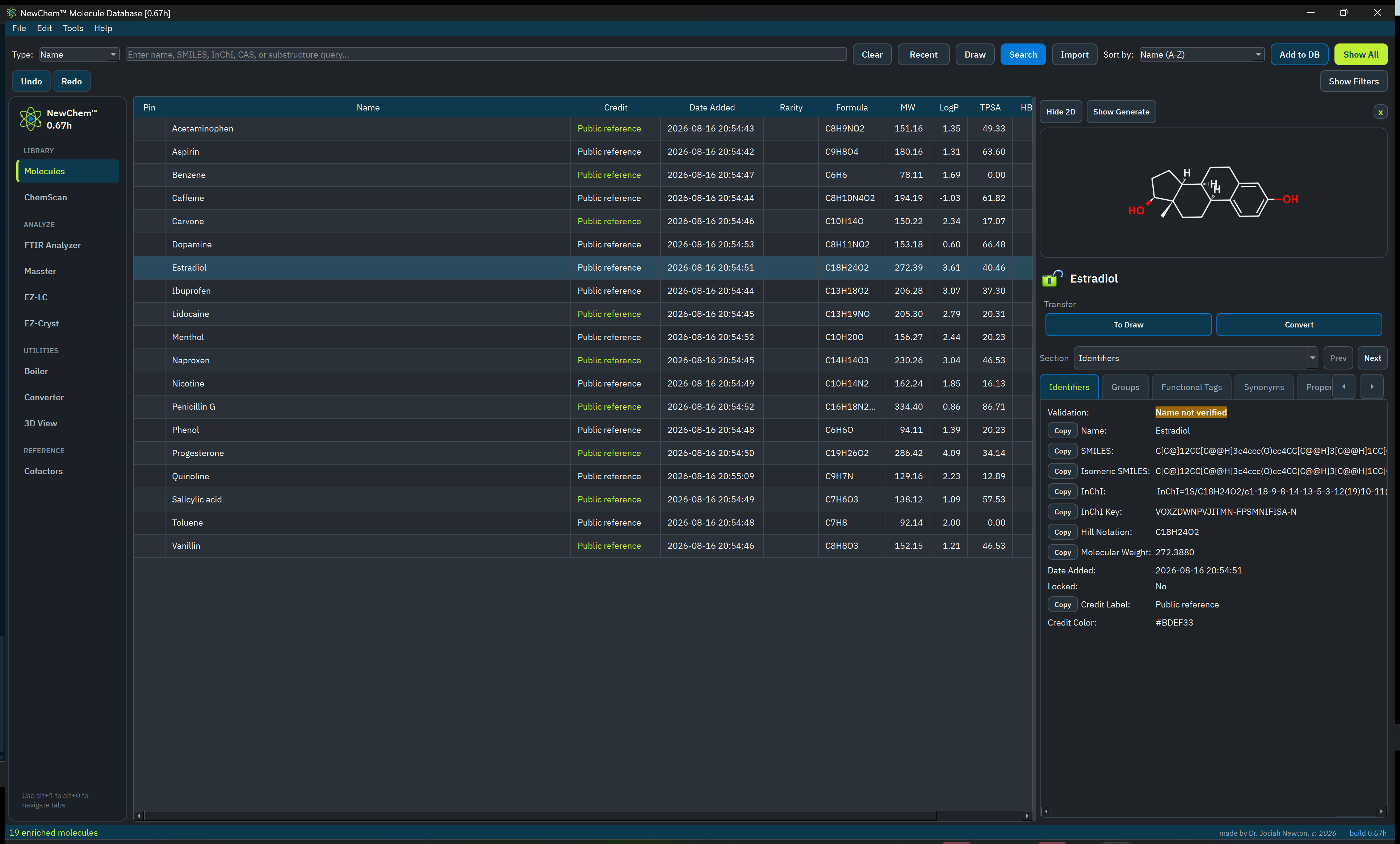
Installed Windows build · verified public-reference examples shown · your library begins empty
Windows 10 & 110.67k native installer
macOS Apple silicon0.67k DMG + PKG
Debian0.67k native package
GPL-3.0-onlyfree and open source
RELEASE NOTE / 0.67h
Tester feedback, made concrete
Sharper guardrails. Fewer dead ends.
0.67h turns hands-on Windows alpha feedback into clearer editor states, safer image review, and an export workflow that tells you exactly where your chemistry went.
WHAT CHANGED
Native Save AsChoose the destination yourself and see the saved path.
Actionable editor statesDisabled monomer and reaction-mapping tools now explain what they need.
One safe reloadA bounded editor retry preserves SMILES, with a visible Reload Editor action.
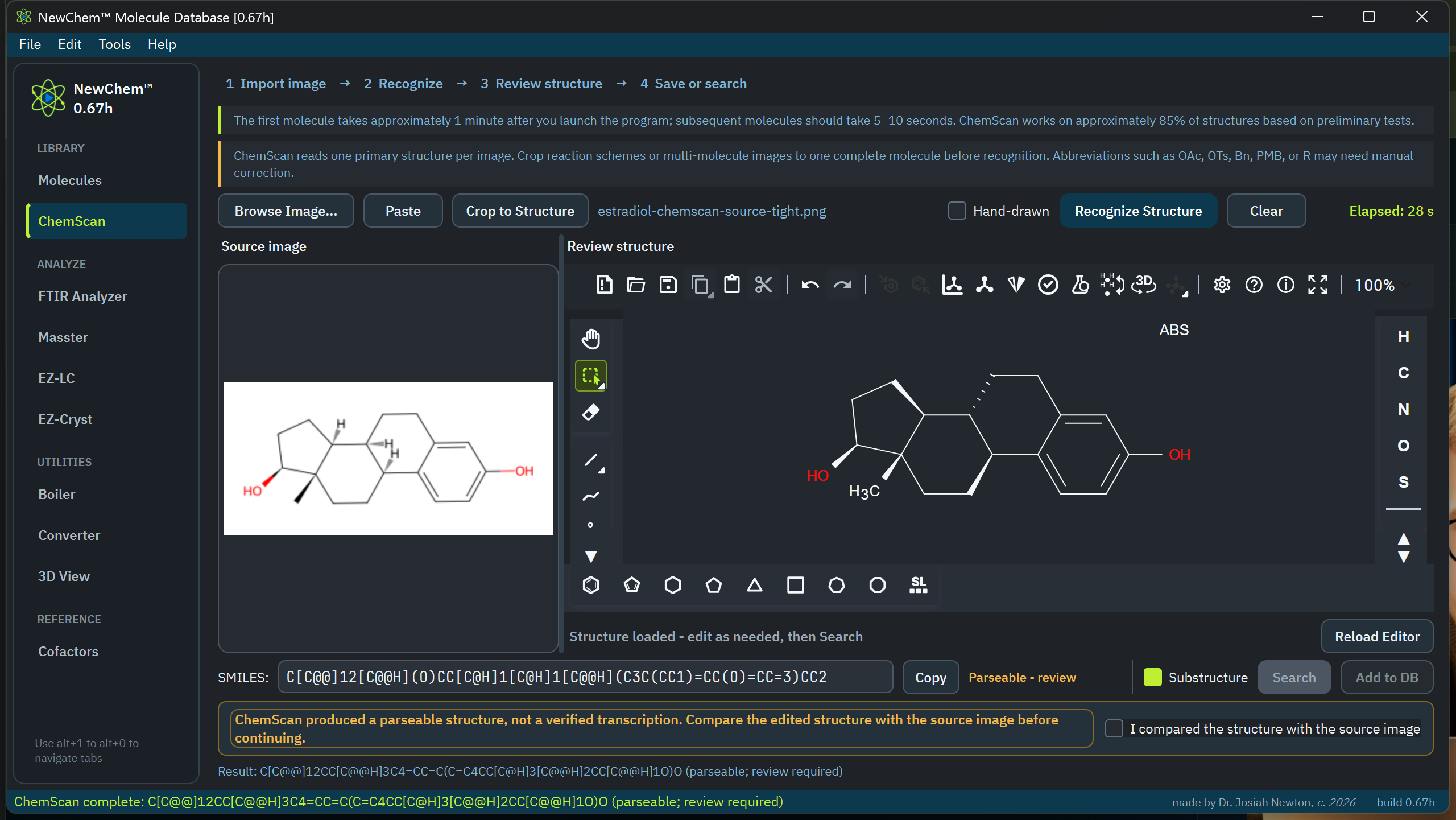
Honest ChemScan reviewCrop to one primary structure; disconnected multi-structure results are blocked from database actions.
Visible limitationsAbbreviations, radicals, and lone-pair boundaries are stated before they surprise you.
Estradiol recognition · compare, edit, and review before use
01 / LOCAL FIRST
Private by default
Your chemistry stays yours.
NewChem™ keeps your molecule library on your machine. Open it without an account, use it without a subscription, and back it up or move it whenever you choose.
Features that need the internet say so. The public installer starts empty, and your personal library never has to leave your computer for everyday work.
02 / ONE WORKSPACE
Ten focused tools
From a structure on paper to a decision at the bench.
01
ChemScan
Turn a structure image into an editable molecule. This Estradiol example preserves a fused four-ring steroid framework and defined stereochemistry in one local recognition pass.
Bring analytical evidence into the same local workspace. Inspect infrared traces or mass spectra, work with peaks, and export the result without handing your files to a hosted viewer.
OMNIC SPA, Bruker OPUS, JCAMP-DX, text, and CSV
MGF mass-spectrometry workflows
Peak review, baseline controls, undo, and export
03 / TOOL INDEX
Shipped in 0.67k
Every tab earns its place.
01
Molecules
Name, SMILES, InChI, CAS, and substructure search; local records, verified-name states, locking, notes, properties, and export.
02
ChemScan
Recognize a structure image locally, edit it, acknowledge the review, and hand the result to search or storage.
03
Masster
Open MGF data, inspect scans and chromatograms, interact with peaks, and review matched adducts.
04
FTIR Analyzer
Open common instrument exports, correct baselines, label bands, track edits, and export spectra.
05
EZ-LC
Generate practical starting-method recommendations from the structure currently selected in your library.
06
EZ-Cryst
Rank solvent-system starting points for crystallization from the selected molecular structure.
07
Converter
Run bench calculations for mass, mmol, concentration, scale-up, density, and stock solutions.
08
Boiler
Estimate pressure-dependent boiling points from a curated local solvent dataset.
09
3D View
Generate and inspect a local RDKit conformer for the selected molecule.
10
Cofactors
Search curated cofactor records and follow enzyme and molecule cross-links.
Prefer a terminal? The included newchem command exposes stable JSON workflows across the library, ChemScan, FTIR, Masster, EZ-LC, EZ-Cryst, Converter, Boiler, 3D View, Cofactors, configuration, and database inspection.
04 / RELEASE 0.67k
NewChem™ 0.67k
One app. Ten tools. Yours.
Keep molecules, spectra, calculations, and decisions together on your own machine. No account. No subscription.
Local library
Your molecule records stay on your machine.
Desktop + CLI
Work visually or automate the same local chemistry tools.
The complete source archive contains the exact NewChem source commit, build scripts, and source for the redistributed GPL/LGPL components. No Dropbox account is required. One heads-up: the builds are unsigned, so Windows or macOS may ask you to confirm the first launch.
You found it early
Chemistry software belongs to chemists.
NewChem™ is being built in the open for people who want capable tools, private data, and ownership of their work. Welcome to the movement.